Bonhomie Club
Point BlankThe Bonhomie Club is a jazz venue whose importance in the story lies in the way Moses Grace turns a place of music, friendship, and public gathering into bait for Dillon Savich. First associated with Pinky Womack’s memorial, the club becomes the scene of a deliberately limited explosion that provokes a crowd’s panic and draws Savich into a second, more direct threat. Its records, owner, workers, and patrons make the danger concrete; its connection to Savich makes the attack personal.
A club defined by music and community
The club’s identity emerges through the people and objects gathered there. Ms. Lilly owns and fiercely protects it, including its jazz records. James Quinlan, an agent who plays saxophone, performs there, while Fuzz works behind the bar and Marvin serves as a bouncer. The venue is also a place Dillon Savich performs on occasion and where he is known to have friends. These connections make it more than a convenient public setting: the club brings together a community that matters to him.
That social role is especially visible at Pinky Womack’s memorial party. Moses Grace asks Savich to praise the party to Ms. Lilly, despite the fact that Moses and Claudia were not inside the club that night. Six undercover agents were there, with hidden cameras, while others watched the entrances from outside. The distinction matters: Moses describes the gathering with the confidence of someone who saw it, but his presence was outside the venue, not among its mourners.
The memorial and the watchers outside
Moses’s account includes precise details about the people at the memorial. He recalls the dark suit and yellow tie worn by D.A.D. Maitland and James Quinlan’s dark suit and red tie, as well as Quinlan carrying a saxophone and playing. He also remarks on the mourners’ tears. The specificity makes his claim of attendance sound persuasive, but Savich knows that Moses and Claudia were not inside. The club’s monitored entrances and undercover agents sharpen the contradiction: the pair had to be watching from outside.
The memorial thus places the club under two kinds of observation. The mourners gather to remember Pinky, while Moses and Claudia watch who enters and use what they see to taunt Savich afterward. His knowledge of the event is not proof that he shared in it; it is evidence of surveillance. The club is already a stage for his game of converting other people’s grief and ordinary social behavior into material for intimidation.
The explosion and the club’s evacuation
At 9:15 one evening, James Quinlan calls Savich to report an explosion at the club. At first, the cause is uncertain; Quinlan says it might have been the boiler. Smoke fills the venue, people are hurt, and panic threatens to cause further harm. Savich leaves home to help. Lacey Sherlock recognizes that Moses may be responsible, but Savich goes regardless: the people inside are their friends.
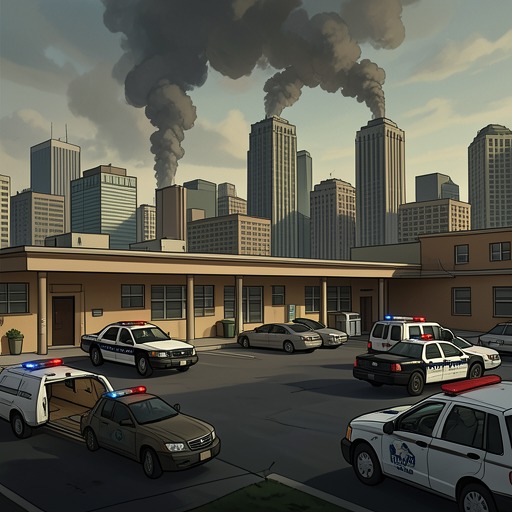
The damage proves limited compared with the fear the blast produces. Detective Millbray identifies a piece of a cell phone used as a homemade detonator. The explosion makes a loud report and sends thick black smoke through the scene, frightening the crowd into a stampede, but causes relatively little physical damage to the club. The contrast between modest destructive force and substantial panic is central to the attack’s effect: the device is useful not only as a bomb, but as a means of directing people’s movements and attention.
Ms. Lilly is safe and immediately occupied with saving the club’s contents. She and a fireman carry out boxes, probably containing records and accounts; her white satin dress is ruined, but she is still directing the firefighters. Fuzz is all right after inhaling smoke and helps evacuate people. Marvin is taken by ambulance to the hospital after going down amid the rush to escape, though the paramedic expects him to recover. These details show the emergency as a threat to a working community as well as to a building: the owner, employees, and patrons must be accounted for even while the cause remains uncertain.
A personal lure and a second bomb
Savich quickly links the blast to Moses. He knows Moses is aware that he performs at the club and is friends with Ms. Lilly, so he asks Sherlock to watch for Moses and Claudia while officers surround her for protection. The response is directed both toward helping the venue and anticipating that the explosion may be part of a broader assault. When Sherlock fires toward a two-story building, Savich is not looking where the shots are aimed. He is watching his Porsche and recognizes the possibility that Moses has planted another bomb there, as he did at Hooter’s Motel. He shouts for the crowd to get away, and police officers join the warning.
The device at the club was therefore not simply a means to damage Ms. Lilly’s business. Savich tells Millbray that he believes Moses chose the venue because it matters to him. Millbray questions why an attacker who knew the owner’s importance to Savich would use a small charge rather than cause a more devastating disaster. The limited blast remains disturbing precisely because its purpose appears calculated: it creates a crisis that draws Savich in without doing the greatest possible damage to the club itself.
Moses later confirms the personal design of the attack. He tells Savich that he selected the Bonhomie Club because Savich’s friends were there and expected him to come. He and Claudia watched the crowd pour out, then saw Savich arrive in his red Porsche. Moses mocks the panic and says the car went up in flames. The club’s place in the episode is consequently twofold: it is the immediate target of a bomb that turns a memorial venue into a scene of fear, and it is the lure that brings Savich within reach of the attack on his car. Its significance rests on this collision between public refuge and private vulnerability: the ties that make the club a community are exactly what Moses exploits.